Most business owners believe their greatest technology risk comes from outside the organization. Ransomware. Cyber attacks. Data breaches. These threats are real, and they deserve attention. But after working closely with companies across multiple industries, one pattern continues to stand out.
The most dangerous threat is usually not external. It is internal — and it often goes unnoticed until it becomes a problem.
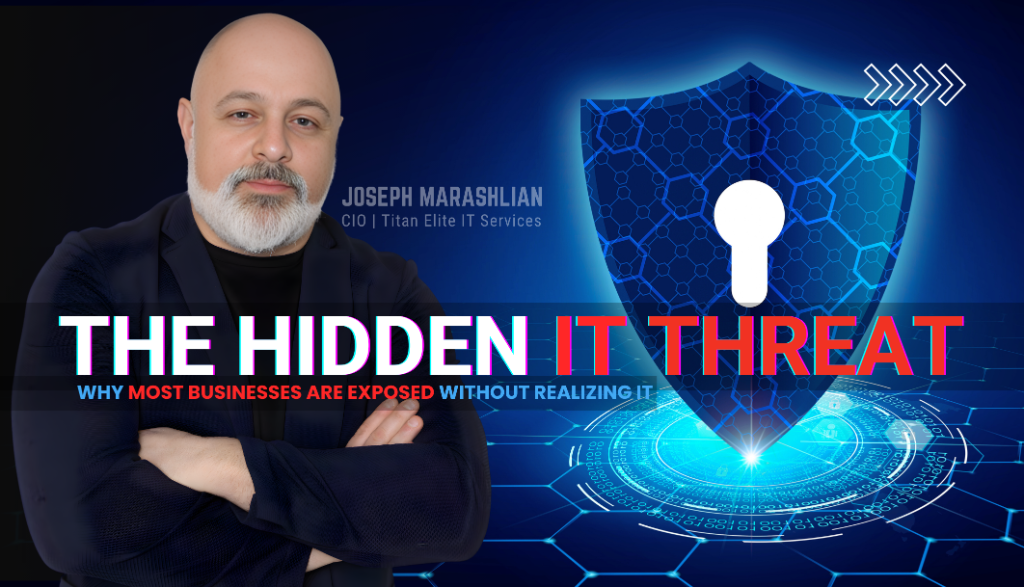
The Real IT Risk Facing Businesses Today
Every business today runs on technology, whether they realize it or not. Client data, financial systems, communication platforms, and daily operations all depend on infrastructure that needs to be secure and reliable. It is no longer just a support function. It is part of how the business operates at its core.
The issue is, most problems do not show themselves right away. On the surface, everything looks fine. Systems are running. Employees are getting their work done. The business continues moving forward.
But behind the scenes, small gaps start to form. Access gets overlooked. Systems go unchecked. Processes fall out of alignment. Nothing feels urgent in the moment. Until it is. That is where most IT problems actually begin.
"Stability does not equal security. Most businesses are operating on assumption instead of control."
How Hidden IT Risks Develop Inside Organizations
Technology environments do not stay static. They evolve over time. New systems are added. Vendors are given access. Employees change roles. Cloud platforms expand. Security tools are layered in. Each change solves an immediate need.
Very few organizations take the time to step back and evaluate how everything works together as a complete system. Over time, this leads to a compounding set of invisible vulnerabilities.
- Outdated or unmonitored infrastructure left running unchecked
- Uncontrolled user access and permissions that were never revoked
- Security tools that are installed but not fully configured
- Backup and disaster recovery plans that have never been tested
- Third-party vendor access that remains long after the engagement ended
These are not dramatic failures. They are quiet gaps. And those gaps are where real risk lives.
Why Most Business Owners Never See It Coming
One of the biggest challenges in business technology is visibility. If nothing is actively breaking, it is easy to assume everything is secure. But that assumption is exactly where exposure begins.
Many business owners are relying on systems that were set up years ago without a clear understanding of how they function today. In many cases, there is no clear answer to critical questions that every leader should be able to answer immediately.
- Who currently has access to our most sensitive systems?
- How quickly can our systems be restored after a failure?
- Are our security tools actively protecting us right now?
- Will our backup systems actually work when we need them?
- What third parties have access to our environment?
Without clear answers to these questions, companies are operating on assumption instead of control. And assumption is not a risk management strategy.
When IT Issues Become Business Problems
At a certain point, technology stops being just an IT concern. It becomes a business risk. A single issue can impact operations, revenue, and client trust all at once.
- Downtime halts productivity across the entire organization
- Security incidents damage client relationships and reputation
- Compliance gaps create legal and regulatory exposure
- Recovery is far more complex and expensive than prevention
The cost is not just technical. It is operational and financial. And the longer the gap persists undetected, the more expensive it becomes to close.
"The most dangerous IT threat is not a hacker. It is the accumulation of small, unseen gaps inside your own organization."
What Strong Organizations Do Differently
The companies that stay ahead of these risks approach technology with a fundamentally different mindset. They do not wait for something to go wrong. They build visibility into their infrastructure and maintain control over their environment as an ongoing discipline — not a one-time project.
- They know who has access to what systems at all times
- They understand how their infrastructure is structured
- They have documented and tested their recovery process
- They review access controls and security configurations regularly
- They treat IT as part of overall business strategy — not just support
That is where real stability comes from. Not from having the most advanced technology — but from maintaining disciplined oversight of the technology you already have.
A Question Every Business Owner Should Ask
If your entire IT environment went down tomorrow, how long would it take your business to recover?
- Hours — You have documented systems, tested backups, and a clear incident response plan.
- Days — Significant operational and financial impact. Recovery is possible but painful.
- Weeks — Potential loss of clients, contracts, and organizational credibility.
Most companies do not have a clear answer. But that answer defines exactly how prepared the business really is. If you do not know, that is the most important data point you have.
The Difference Between Assumption and Control
Most organizations are not ignoring their technology. They are doing what they believe is enough. But without structured oversight, even well-intentioned systems can create compounding risk over time.
The difference between businesses that struggle and those that remain stable often comes down to one thing: control. When leadership understands their infrastructure, risk becomes manageable. When they do not, risk becomes unpredictable.
"The organizations that succeed long term are not the ones with the most advanced technology. They are the ones with the most discipline in how it is managed."
Final Thought
The hidden IT threat is not always a hacker or an external attack. More often, it is the accumulation of small, unseen gaps inside the business itself. In today's environment, that discipline is not optional. It is part of protecting everything you have built.
If you are ready to move from assumption to control, schedule a conversation with Joseph Marashlian to review your current environment and build a clear path forward.